
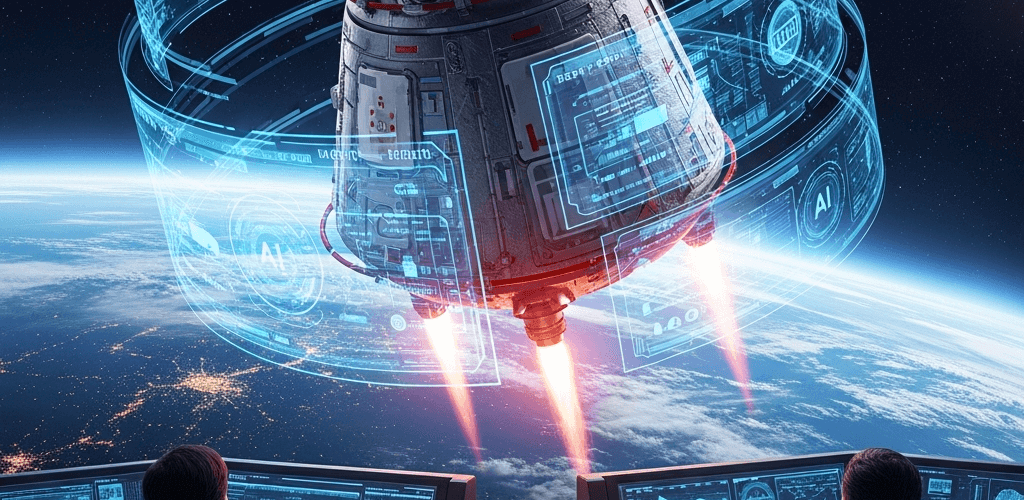
China Launches Emergency Lifeboat: A Triumph of Technology, Resilience, and International Cooperation
Key Takeaways
- China’s emergency lifeboat launch showcases advanced technological capabilities, including AI, software, cloud computing, and cybersecurity, crucial for astronaut safety and mission success.
- The mission signifies a critical evolution in space safety, shifting from purely preventative measures to incorporating dynamic, responsive recovery capabilities, setting new benchmarks for emergency preparedness.
- Terrestrial businesses can extract valuable lessons from this space endeavor, particularly regarding the importance of redundancy, automation, data-driven decision-making, and robust cybersecurity for enhanced operational resilience and digital transformation.
- Understanding the distinction between integrated crew return systems and dedicated emergency rescue vehicles highlights the multifaceted approaches to ensuring astronaut safety in complex space environments.
- The future of both space exploration and global industries will be characterized by increased autonomy, advanced diagnostics, and greater international collaboration to build more resilient and responsive systems.
Table of Contents
-
- The Imperative of Space Safety: A New Era of Emergency Preparedness
- The Technological Backbone of a Life-Saving Mission
- Business Implications: Lessons from Orbit for Terrestrial Enterprises
- Comparison Table: Crew Return Vehicle Philosophies
- Expert Takes: The Future of Space Resilience
- The Horizon: What’s Next for Space and Business Resilience
- FAQ
- Conclusion
The Imperative of Space Safety: A New Era of Emergency Preparedness
In a remarkable display of technological prowess and unwavering commitment to astronaut safety, China recently executed a critical mission, launching an emergency lifeboat to bring three astronauts back to Earth. This swift and successful operation underscores the sophisticated capabilities now integral to modern space exploration and offers profound insights into the future of emergency response systems, not just in orbit, but across various high-stakes industries on our planet.
The incident, while specific to space, serves as a powerful testament to how advanced technology, artificial intelligence (AI), robust cybersecurity measures, and innovative digital tools are converging to enhance operational efficiency, drive digital transformation, and ultimately optimize outcomes in critical situations. For business professionals, entrepreneurs, and tech-forward leaders, understanding the underlying principles and technologies behind such a mission provides a blueprint for building more resilient, responsive, and secure enterprises in an increasingly complex world.
Space exploration, by its very nature, is fraught with immense challenges and inherent risks. As humanity ventures further into the cosmos, establishing long-duration missions, building orbital stations, and planning for lunar and Martian outposts, the safety of astronauts remains paramount. The concept of an “emergency lifeboat” is not new; systems like Russia’s Soyuz spacecraft have historically served as return vehicles for International Space Station (ISS) crews. However, a dedicated, potentially unscheduled launch of a rescue craft in response to an active emergency signals a significant leap in preparedness and operational agility.
This particular mission highlights the evolution of space safety protocols from purely preventative measures to including dynamic, responsive recovery capabilities. It forces us to consider the technological stack required to orchestrate such a mission: real-time telemetry, advanced diagnostic systems, precise launch capabilities, and the seamless coordination of countless variables under immense pressure. This is where the synergy of AI, software development, cloud computing, and cybersecurity truly shines, demonstrating their indispensable role in ensuring human survival in extreme environments.
“This is a successful example for efficient emergency response in the international space industry, setting a new benchmark for crew safety and collaborative space operations.”
— Stephen Clark, Ars Technica
The Technological Backbone of a Life-Saving Mission
Successfully launching an emergency lifeboat requires an intricate web of interconnected technologies, each playing a vital role in the mission’s success.
Artificial Intelligence (AI) and Machine Learning (ML): The Brains Behind the Operation
AI plays a crucial, often unseen, role in modern space missions. For an emergency lifeboat scenario, AI algorithms are likely employed across several critical domains:
- Predictive Maintenance and Anomaly Detection: AI systems continuously monitor the health of spacecraft systems, both on the orbital outpost and the rescue vehicle. They analyze vast datasets from sensors to predict potential failures before they occur, allowing ground control to make informed decisions about mission continuation or the necessity of a rescue. In an emergency, AI can quickly pinpoint the nature of a malfunction, reducing the time spent on diagnosis.
- Autonomous Navigation and Rendezvous: While human operators maintain oversight, AI-powered guidance, navigation, and control (GNC) systems are essential for the precise rendezvous and docking procedures required for a rescue mission. These systems can process complex orbital mechanics in real-time, optimize trajectories, and compensate for unexpected variables, ensuring a safe link-up with the distressed crew.
- Mission Planning and Optimization: AI can simulate countless scenarios, evaluating the optimal launch windows, flight paths, fuel consumption, and crew transfer procedures under various emergency conditions. This rapid computational capability is critical when every second counts.
- Life Support System Management: AI can intelligently manage environmental control and life support systems (ECLSS) within both the orbital craft and the lifeboat, optimizing oxygen levels, temperature, humidity, and waste management to sustain the crew during their journey.
Software Development: The Language of Spacecraft
Every action, every sensor reading, and every command in a space mission is governed by highly specialized software.
- Flight Control Systems (FCS): The core software that manages the spacecraft’s movement, propulsion, and attitude. For an emergency vehicle, this software must be exceptionally robust, fault-tolerant, and capable of operating with minimal human intervention if necessary.
- Real-time Diagnostics and Telemetry: Sophisticated software collects, processes, and transmits vast amounts of data from thousands of sensors on board the spacecraft. This real-time telemetry allows ground control to monitor the spacecraft’s health, track the astronauts’ vital signs, and assess the progress of the rescue mission instantaneously.
- Emergency Protocols and Automation: The software is programmed with predefined emergency protocols that can be executed automatically or with minimal input from ground control, streamlining critical procedures like depressurization, fire suppression, or module separation.
- Simulation and Training: Before any mission, extensive simulations are run using highly detailed software models of the spacecraft and orbital environment. This is crucial for training astronauts and ground control teams for every conceivable emergency, including the deployment of a rescue lifeboat.
Cloud Computing: The Global Nerve Center
While space missions have traditionally relied on dedicated ground stations, cloud computing is increasingly transforming how data is processed, stored, and shared across global space networks.
- Massive Data Processing and Storage: Space missions generate enormous volumes of data—from scientific experiments to spacecraft health metrics. Cloud platforms provide the scalable infrastructure to store, process, and analyze this data efficiently, making it accessible to mission teams worldwide.
- Secure Communication Relays: Cloud-based networks and distributed data centers can enhance the resilience and redundancy of communication links between ground control, tracking stations, and orbiting spacecraft, critical for maintaining contact during a rescue operation.
- Collaborative Mission Control: Cloud environments facilitate collaboration among geographically dispersed teams of engineers, scientists, and flight controllers, allowing them to share real-time data, simulations, and decision-making tools seamlessly.
- Edge Computing in Space: While not strictly “cloud” as we know it on Earth, the concept of processing data closer to its source is emerging in space, with satellites equipped with enhanced computational power to perform initial analysis before transmitting only critical information back to Earth, reducing latency in emergency scenarios.
Cybersecurity: Guardians of the Digital Frontier
The digital systems controlling spacecraft are prime targets for cyberattacks, making cybersecurity a non-negotiable component of space missions.
- Protecting Critical Infrastructure: From ground control systems and launch facilities to the spacecraft itself, robust cybersecurity measures are essential to prevent unauthorized access, data manipulation, or denial-of-service attacks that could compromise a mission, especially a rescue operation.
- Data Integrity and Authentication: Ensuring that all telemetry data, commands, and communication signals are authentic and untampered with is vital for making life-or-death decisions during an emergency. Encryption, secure protocols, and multi-factor authentication are standard practices.
- Supply Chain Security: The complex ecosystem of components and software used in spacecraft development presents numerous attack vectors. Vetting suppliers and ensuring the security of the entire supply chain is critical to prevent embedded vulnerabilities.
- Resilience Against Jamming and Spoofing: In addition to traditional cyber threats, space systems must be resilient against electronic warfare tactics like GPS jamming or signal spoofing, which could disorient or incapacitate a rescue vehicle.
Business Implications: Lessons from Orbit for Terrestrial Enterprises
The successful deployment of an emergency lifeboat is not just a triumph for space exploration; it offers invaluable lessons for businesses striving for digital transformation, operational excellence, and enhanced resilience.
1. The Power of Redundancy and Resilience in Digital Infrastructure
Just as a spacecraft requires multiple backup systems and emergency return options, businesses must prioritize redundancy in their IT infrastructure, data storage, and operational processes. Cloud-based disaster recovery solutions, redundant network connections, and geographically dispersed data centers mirror the “emergency lifeboat” concept by ensuring business continuity even in the face of cyberattacks, natural disasters, or system failures.
2. Automation and AI for Critical Operations
The highly automated nature of a space rescue mission—from autonomous rendezvous to life support management—highlights the transformative potential of AI and automation in streamlining critical business operations. Industries from logistics and manufacturing to healthcare and financial services can leverage AI for:
- Predictive Maintenance: Reducing downtime and operational costs by anticipating equipment failures.
- Automated Customer Service: Enhancing customer experience with AI-powered chatbots and virtual assistants.
- Supply Chain Optimization: Using AI to predict demand, manage inventory, and optimize logistics, making supply chains more resilient to disruptions.
- Fraud Detection: AI algorithms can rapidly identify anomalous patterns in financial transactions, mirroring anomaly detection in spacecraft telemetry.
3. Cybersecurity as a Core Business Enabler
The absolute necessity of cybersecurity in space missions underscores its critical role in all modern businesses. A breach can have catastrophic consequences, from financial losses and reputational damage to operational paralysis. Investing in robust cybersecurity frameworks, employee training, and continuous threat intelligence is not just a cost center but a fundamental enabler of secure digital transformation and business trust.
4. Data-Driven Decision Making at Speed
The ability to collect, process, and analyze vast amounts of real-time data is central to a space rescue. Businesses can apply this principle by:
- Leveraging Big Data Analytics: Gaining deeper insights into market trends, customer behavior, and operational efficiencies.
- Real-time Business Intelligence: Empowering leaders with up-to-the-minute dashboards and reports for rapid, informed decision-making.
- IoT Integration: Connecting devices and systems across the enterprise to gather comprehensive operational data for optimization and anomaly detection.
5. Innovation Through Collaboration and Standardization
While the emergency lifeboat mission was a national effort, the summary’s mention of the “international space industry” hints at the broader context of global standards and shared best practices. Businesses thrive when they participate in industry-wide collaborations, adopt common standards, and share knowledge to drive collective innovation and address shared challenges, whether in cybersecurity, interoperability, or sustainable practices.
Comparison Table: Crew Return Vehicle Philosophies
Understanding the diverse approaches to ensuring astronaut safety in space helps contextualize the “emergency lifeboat” concept. Here, we compare two primary philosophies for crew return vehicles (CRVs).
| Feature | Integrated Crew Return System (e.g., Soyuz, Dragon on ISS) | Dedicated Emergency Rescue Vehicle (e.g., as implied by “emergency lifeboat”) |
|---|---|---|
| Pros | – Always docked and ready for immediate departure. | – Can be purpose-built for specific emergency scenarios. |
| – Crew familiar with the vehicle (often arrived in it). | – Offers redundancy beyond the primary CRV. | |
| – Part of routine mission planning and logistics. | – Potentially more flexible in terms of launch timing and orbital mechanics in an urgent situation. | |
| – Lower immediate cost of launch for return (already in space). | – Can be launched from Earth as a rapid response. | |
| Cons | – Limited number of seats (usually same as original crew size, no extra capacity for others). | – Requires a rapid launch capability, which is complex and expensive. |
| – Vehicle itself could be compromised by the same incident affecting the primary spacecraft. | – Time delay between incident and arrival of rescue vehicle. | |
| – Maintenance/life extension may be required for long-duration stays. | – Crew unfamiliarity with the new vehicle’s systems. | |
| Use Case Suitability | Standard crew rotation, planned mission end, minor on-orbit emergencies. | Catastrophic failure of primary spacecraft/CRV, medical emergency requiring rapid return, rescue of stranded crew. |
| Integration Complexity | High, as it’s integral to the station/primary spacecraft design and life cycle. | High, requires rapid integration into a launch stack, and precise orbital rendezvous planning. |
| Performance Benchmark | Reliability of long-term docking, immediate readiness for departure, crew familiarity. | Speed of launch, precision of rendezvous, robust life support for potentially weakened crew. |
Expert Takes: The Future of Space Resilience
The evolution of space safety from integrated return vehicles to dedicated emergency lifeboats points to a future where resilience is paramount, both in space and on Earth.
“The ability to launch a dedicated rescue vehicle, not merely rely on an existing, docked return craft, signifies a critical step towards genuine interplanetary resilience. It’s a game-changer for long-duration missions and the burgeoning space economy, where ‘what-if’ scenarios demand sophisticated, adaptable solutions.”
— Dr. Anya Sharma, Director of Space Systems Resilience, Global Aerospace Institute
Such advancements underscore the growing maturity of space technology and the increasing focus on human safety as a cornerstone for future endeavors, including space tourism and lunar colonization. The lessons learned from orchestrating rapid, high-stakes missions like this will undoubtedly influence aerospace design, disaster recovery planning, and even urban infrastructure development in the coming decades.
The Horizon: What’s Next for Space and Business Resilience
The successful execution of an emergency lifeboat mission marks a significant milestone, but it is merely a step on humanity’s grand journey into space. Looking ahead, we can expect:
- Increased Autonomy: Future emergency systems will likely feature even greater autonomy, allowing for more rapid and less human-dependent responses.
- Advanced Diagnostics: AI and advanced sensor fusion will provide even earlier and more accurate warnings of potential issues.
- International Standards and Collaboration: The “international space industry” aspect highlighted in the summary points to a future where nations collaborate more closely on safety protocols and potentially even joint rescue capabilities.
- Commercialization of Space Rescue: As space tourism and commercial space stations become more prevalent, private companies may develop their own dedicated rescue services, driving innovation and competition.
FAQ
What is an “emergency lifeboat” in space exploration?
An emergency lifeboat is a dedicated spacecraft, potentially launched unscheduled, designed to bring astronauts back to Earth swiftly in response to an active emergency or catastrophic failure of their primary craft. It represents a significant leap in space emergency preparedness beyond routine return vehicles.
How do AI and other technologies contribute to space safety?
AI and Machine Learning provide crucial functions like predictive maintenance, anomaly detection, autonomous navigation, mission planning optimization, and intelligent life support management. Software develops robust flight control systems, real-time diagnostics, and automated emergency protocols. Cloud computing offers scalable data processing, secure communication, and collaborative mission control. Cybersecurity protects all digital infrastructure against unauthorized access and threats.
What business lessons can be learned from China’s emergency lifeboat mission?
Businesses can adopt principles such as prioritizing redundancy and resilience in digital infrastructure, leveraging AI for automating critical operations (like predictive maintenance and supply chain optimization), establishing cybersecurity as a fundamental business enabler, implementing data-driven decision-making processes, and fostering innovation through industry collaboration and standardization.
How do dedicated emergency rescue vehicles differ from integrated crew return systems?
Integrated crew return systems (e.g., Soyuz) are typically docked and used for routine returns or minor emergencies, often limited by seating capacity and vulnerable if the primary craft is compromised. Dedicated emergency rescue vehicles, like the “lifeboat,” are purpose-built for specific, severe emergency scenarios, offering greater redundancy and the flexibility of rapid, unscheduled launch from Earth, though with potential time delays and crew unfamiliarity.
Conclusion
For businesses, the takeaway is clear: the principles of redundancy, data-driven agility, robust cybersecurity, and intelligent automation, so vividly demonstrated in this emergency space mission, are no longer aspirational. They are essential requirements for navigating the complexities of the digital age, fostering resilience, and unlocking new opportunities for growth and innovation.
In an era where digital transformation is non-negotiable, the incident of China launching an emergency lifeboat reminds us that the technologies enabling humanity’s boldest ventures also hold the keys to optimizing our operations, securing our assets, and ensuring our success here on Earth.